Play the ancient game of the Pharaohs.
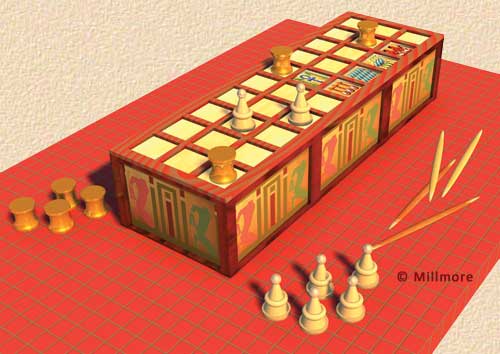
Board games were a favourite pastime in Egypt, and Senet was the most popular of these. It was played by two people, either on elaborate carved and inlaid boards like the one found in Tutankhamen’s tomb, or simply scratched into the earth. The oldest known representation of Senet is in a painting from the tomb of Hesy, from 2686 BC.
Many actual boards, with their counters and throw sticks (or “knucklebones”) have survived intact, but the rules of the game are not fully understood, there have been several attempts to reconstruct the game. Senet, means “passing” and had a religious significance – the aim of each player being to move their pieces around the board and avoid hazards.
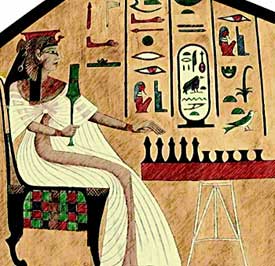 The game board had thirty squares laid out in three rows of ten. Some squares had symbols on them, and the path of the counters followed a reversed S across the board.
The symbols represented either good or bad fortune and affected the play.
The movement of the counters was decided by throwing four two-sided sticks or, knuckle bones.
Good luck was a blessing from the gods, and the winner was the first to pass into the afterlife by getting all their pieces off the board.
With colourful -graphics and fun sound effects, this reconstructed version of Senet is not only a game of chance, a bit of skill and strategy is also required.
