Ancient Egyptian Hieroglyphic writing, numerals and mathematical problems using the ancient numbers and the Rosetta stone.
Champollion & Egyptian Hieroglyphic Writing
Ancient Egyptian history covers a continuous period of over three thousand years. To put this in perspective – most modern countries count their histories in hundreds of years. Only modern China can come anywhere near this in terms of historical continuity.
Egyptian culture faded and disappeared two thousand years ago. The last vestiges of the living culture ceased to exist in AD 391 when the Byzantine Emperor Theodosius I closed all pagan temples throughout the Roman Empire.
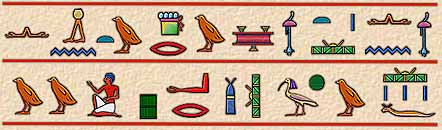
Hieroglyphs were called, by the Egyptians, “the words of God” and unlike the simple elegance of modern writing systems, this early attempt at recording words used several techniques to convey meaning. The picture symbols represent a combination of alphabet and syllabic sounds together with images that determine or clarify meaning and depictions of actual objects, which are the spoken word of the thing they represent.
All writing systems likely evolved in this way, but their original forms were lost as pictures were refined to a simple abstraction, making writing an efficient tool for day-to-day business. The Egyptians intentionally preserved Hieroglyphs in their original forms because they believed them to be a gift from the gods with magical powers. So they inscribed them on temple walls, tombs, objects, jewellery and magical papyri to impart supernatural power not for mundane day-to-day communication.
It was not until Napoleon’s invasion of Egypt in 1798 that the wonderful artefacts of the Egyptians were seen in Europe and their ancient culture awakened from its long slumber. In 1799 a French captain named Pierre Bouchard discovered the Rosetta Stone which was carved with the same text in two languages, Egyptian and Greek, and three writing systems, hieroglyphic, Demotic, and the Greek alphabet.
 This was a tremendous piece of luck because it enabled scholars to unlock the hieroglyphic code and without the stone, we would know nothing of the ancient Egyptians, and the details of their three thousand years of history would remain a mystery.
The man who did more than any other to recover the words of the ancient Egyptians was Jean-François Champollion. He was a historian and brilliant linguist and by the age of sixteen had mastered not only Latin and Greek but six ancient Oriental languages, including Coptic, which was the late form of ancient Egyptian.
Champollion had a unique advantage over others in the task of cracking the hieroglyphic code. Because he understood Coptic he could translate the meanings of the ancient Egyptian words.
In the 1820s, Champollion established an entire list of Egyptian symbols with their Greek equivalents and was the first Egyptologist to realise that the symbols were not only alphabetic but syllabic, and in some cases determinative, meaning that they depicted the meaning of the word itself.
Egyptian Hieroglyphic Writing
Hieroglyphic symbols are pleasing to the eye; everyone wants to see their name in hieroglyphs. But understanding the ancient script is difficult and, unless you’re interested in the finer points of Egyptian religion, make tedious reading (the contents of hieratic papyri are far more fascinating). However, gaining some understanding of the hieroglyphic writing system can be fun and instructive. It is possible to quickly gain enough knowledge, with a bit of study, to recognise the names of pharaohs – which is useful if you are planning a trip to Egypt.
Egyptian Hieroglyphic Alphabet
Egyptian Mathematics Numbers Hieroglyphs
Egyptian Hieroglyphic Typewriter